In the one month that I´ve been living in Tlaxco, I´ve asked ¿te puedo ayudar?/can I help you? countless times. Usually when I´d say these words, I´d be awkwardly standing towards the wall or corner fiddling with my hands and watching people in my host community effortlessly swirl about -cleaning, cooking, preparing, organizing, getting kids into line, giving out instructions, returning homework etc etc. I´d keenly observe what was going on around me, ask if I could help in someway and await (hopefully) very detailed instructions on how I could possibly assist in a non obtrusive and at least somewhat productive way.
Poco a poco/little by little , I´ve be able to integrate myself more and more into the work of la escuelita and my home, thanks entirely to the seemingly boundless patience of my host family and the other teachers at IEIMC. They have so graciously allowed me and my broken spanish to "help," whether they truly needed another set of hands or not (usually the latter). They saw my desire to be in community with them and patiently allowed me to "help." They saw my desire to belong, to contribute, to do something other than awkwardly watch and fiddle with my hair. In allowing me to help, they´ve in turn provided me with the critical help I needed in these awesome, uncomfortable and challenging weeks of transition. They've provided me the opportunity to carve out little spaces and places of regularity and routine. They've helped me begin to build an identity in this community that is built on tasks and action, one that goes beyond my obvious foreignness.
The joy I felt this week when I successfully put away the dishes in their correct spot with my host mom after comida was ridiculous. When she smiled and noted, "I didn't even have to tell you where they belong!" a sizeable lump of gratitude and contentment grew in my throat. Slowly feeling like I'm becoming a part of this community, in moments such as these, has brought so much peace to a time when peace can sometimes be elusive.
Help is a tricky thing, this year I'm sure will continue to challenge my understanding of help and helping. For now, I'm happy to say that over the past few days I've lessened my usage of "¿Te puedo ayudar?" Now I more often find myself saying te ayudo/I'll help you, or even better, just silently beginning to work alongside my companions without feeling the need to announce my presence.
In the month that I've been living in Tlaxco, I've come to feel that our cultural understanding of help really rather wonky. I always felt the need to ask permission before offering assistance or beginning to work alongside. I never really thought about the words I was saying, I asked "te puedo ayudar" so thoughtlessly it was almost a reflex. As I began to pay closer attention to myself and my surroundings, I realized that for as many countless times I've asked permission to help, that same question was never asked of me.
My host sister didn't ask if I understood the meaning of the idiom she just used, she just kindly explained it to me, knowing it wouldn't have been something my Spanish minor would have covered. When my host mom saw that I was walking around the house without sufficient slippers for our tile floor, she immediately gave me an extra pair of her daughter's. When I so clearly had no idea what I was doing in the hortaliza/garden, Maestra Lupita didn't ask me if I needed or wanted help, she just drew me a diagram of the different plant beds so that I would better understand. The complete stranger seated next to me on the bus to Apizaco who saw that I was unsure and uncomfortable, made sure I knew when and where I should get off. In four short weeks here I could fill a lengthy notebook of the times I've received help that I neither asked for nor was asked if I needed.
I think I've never been asked "te puedo ayudar" because it's a silly and irrelevant question. When my community saw an awkward, tall, homesick, unsure, blonde gringa, they immediately showered me with love, support, and help. They saw a need and responded. There was no need to ask any questions.
I think we hesitate and ask "te puedo ayudar" because we worry that stepping in to assist another is assuming that they can't do it on their own. When we need to ask for help, we feel we've failed. In a culture that puts an absurd and at times harmful premium on self sufficiency and independence, asking for help means we've fallen short. Help leaves us feeling lesser.
My experience this past month has proven to me the ridiculousness of this notion. The incredible amount of help I've received has left me feeling loved, empowered, lifted up, greater. My community isn't telling me "you can't do it on your own, so I'll help you," but rather "you don't need to do it on your own, I'll help." In one short month my community in Tlaxco has taught me what it truly means to be in relationships rooted in the notions of accompaniment, mutuality and interdependence. In the coming 10, I hope and pray I'll be able to follow in their example.
Friday, October 16, 2015

Thursday, October 1, 2015
día de las salidas al campo
Most every Tuesday this summer was outing day. It was undoubtedly the absolute best thing about being the Pioneer B Area Director at Lutheridge. Each week, I would sit in the Senior Staff room pouring over maps of Pisgah National Forrest looking at new potential outing sites and debating if connecting this waterfall and that dinner site with this short hike would be a feasible outing. Every Tuesday lunch was like Christmas morning to me. As I ran about camp grabbing the last minute things we´d need to take with us for the afternoon, my grin was as wide as a six year old who got exactly what he wanted from Santa.
We´d pull offsite to the resounding choruses of silly camp songs and wind our way through the Blue Ridge Parkway. Between the songs and stories and jokes I´d hear gasps and little choruses of "wow" and "ohmygosh!". My heart would be so full of children marvelling at the awesomeness of creation before them. We´d arrive at our hike or dinner spot or base of the waterfall and I'd be treated to watching community develop in its truest and most unadulterated manner. Children would make friends with campers in other cabin groups, counselors would mingle with campers they hadn´t before engaged, new counselors would show initiative while returning staff would beautifully lead from the middle, meanwhile that one camper who had been observing on the outskirts finally dove headfirst into a new friendship and that one who´s faith had been rocky experienced the divine in an entirely new way. Outing day was my favorite day.
Every Tuesday this year at Instituto de Educación Integral de Magdalena Cervantes is outing day. Or día de las salidas al campo. Every grade experiences one class period out on the shores of the nearby river or in the fields and trails of the moutains beckoning just outside the school´s gate. I have the absolute honor of accompanying each of these groups. Tuesday is undoubtedly the best thing about being a YAGM at IEIMC. When it´s la hora de salir (time to leave) the children respond to the word "formense!" (line up!) with so much gusto their pens and notebooks are almost left spinning on their desks. After a mad dash to the school gate, the teacher performs one last head count (a very familiar move) and we´re off. As it is the tail end of the rainy season, we head to the river to take advantage of seeing its beauty before it dries up in dry winter season.
I´m pulled in a million directions as soon as we arrive the precious children are eager to show me their favorite spot to dip their feet in, the best rock for sitting and soaking up the sun , their favorite slope to roll down, the oldest and biggest cactus plant, and the best place to scamper up the rocks and admire the view. I watched classes of first and second graders sit in a circle and try to count the different types of trees around them. I saw the elation and surprise on their faces when they realized that there were too many to even count! I watched 3rd and 4th graders help each other to wade across the river so that all could be included in a game of tag on the opposite shore. I watched 5th and 6th graders get to just relax with their teacher, dip their toes in the water and talk about life.
The joys and benefits of outings are universal. By taking, even just an hour, to experience creation and the beauty of community without the bounds of our tiresome and meddlesome institutions we are treated to an incredible growth in relationship with one another and relationship with God. It´s no wonder that whenever Jesus meant serious business he went out-out to the mountain, out the dessert, out the sea, out the garden. Out into creation to experience it with His community. What a joy I have this year to get to go OUT and experience creation with mine.
We´d pull offsite to the resounding choruses of silly camp songs and wind our way through the Blue Ridge Parkway. Between the songs and stories and jokes I´d hear gasps and little choruses of "wow" and "ohmygosh!". My heart would be so full of children marvelling at the awesomeness of creation before them. We´d arrive at our hike or dinner spot or base of the waterfall and I'd be treated to watching community develop in its truest and most unadulterated manner. Children would make friends with campers in other cabin groups, counselors would mingle with campers they hadn´t before engaged, new counselors would show initiative while returning staff would beautifully lead from the middle, meanwhile that one camper who had been observing on the outskirts finally dove headfirst into a new friendship and that one who´s faith had been rocky experienced the divine in an entirely new way. Outing day was my favorite day.
 |
| 3rd and 4th graders head off on their salida |
 |
The joys and benefits of outings are universal. By taking, even just an hour, to experience creation and the beauty of community without the bounds of our tiresome and meddlesome institutions we are treated to an incredible growth in relationship with one another and relationship with God. It´s no wonder that whenever Jesus meant serious business he went out-out to the mountain, out the dessert, out the sea, out the garden. Out into creation to experience it with His community. What a joy I have this year to get to go OUT and experience creation with mine.
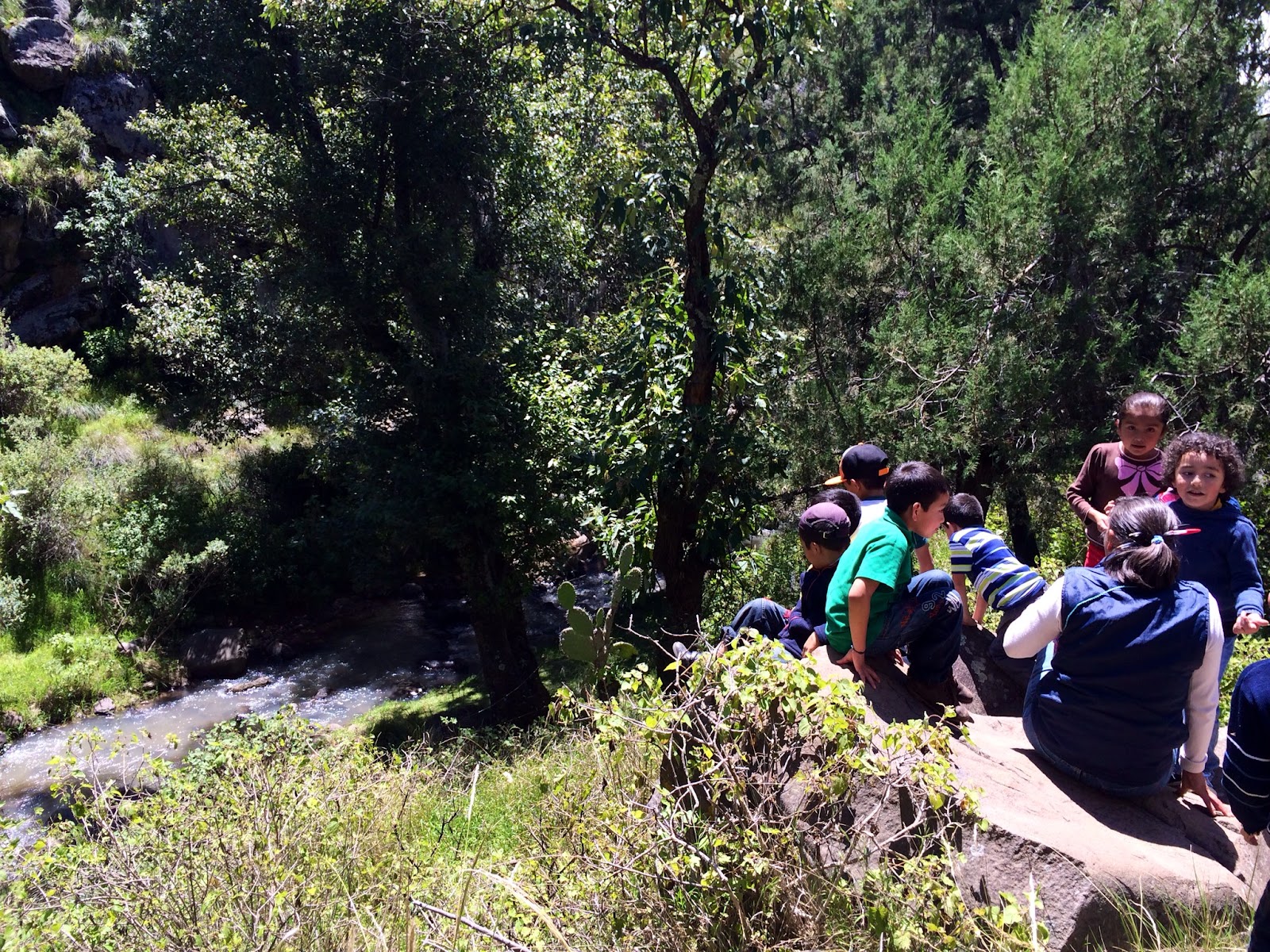 |
| 1st and 2nd graders pause and chat with their teacher about their experience |
Tuesday, September 15, 2015
sitios de trabajo
As I sit in my room at el centro Luterano surrounded by my years worth of belongings that has been packed and unpacked and repacked to accommodate our 3 week in-country orientation, I think it might possibly be beginning to sink in that I'm actually here in Mexico and that tomorrow I move to Tlaxco to really dive into my YAGM experience. Obviously blogging about the amazing worksites we've had the privilege to visit is the most efficient use of my time... (apparently procrastination exists after college too).
One of the unique aspects of the YAGM Mexico program is the diversity of worksites. As we are not part of an ELCA global companion church here in Mexico, our worksites are the product of the relationships our country coordinators (and previous country coordinators) have built with various social service organizations throughout the country. As we have 2 more volunteers than last years YAGM cohort, we have a few new work sites (mine included!) and the spirit of accompaniment of YAGM continues to be graciously embraced and welcomed in more and more awesome organizations. While the missions of various organizations in which we are working are vastly different (labor rights to dry toilets to indigenous libraries), the same spirit of radical hospitality and an incredible passion for serving creation was palpable in each visit over the past 3 weeks. Below is a list of the 13 amazing organizations where my compadres and I will be serving with and all too brief explanations that do not at all do the organizations justice. I hope this helps give some context to our group's year. More than anything, I hope this shows the beautiful diversity of passion, love, spirit, and joy that accompanies the call to love thy neighbor.
Tochan: Nuestra Casa, Mexico City (Grace)
Tochan is the Nauhatl word meaning "our home" and provides long term shelter for refugees and migrants. Many of it's guests are Central Americans fleeing violence, poverty, and political instability. Many have experienced human rights abuses along their journey. Tochan provides shelter and stability while channeling their guests to other organizations that can help meet their needs (medical, financial, documentation, psychological, etc)
Casa de los Amigos, Mexico City (Grace)
Casa de los Amigos is a bit more challenging to describe-it's part hostel, part shelter, part Quaker meeting house, part community center, part advocacy center, part awesome place for all, with sustainable living practices. Needless to say, its a force to be reckoned with as far as social service providers go in Mexico City.
Centro Juvenil, Mexico City (Gracia)
Centro Juvenil is a youth center in the city that focuses on providing a safe and accountable play environment for the city's youth. Utilizing schools and local parks, they provide activities in ways that enrich the children's social, academic and physical well-being.
Centro de Estudios Ecumenicos, Mexico City (Gracia)
CEE is a national organization that unites different faith communities under common social justice issues. They were founded in the 1960's and have been a force of comfort, solidarity and empowerment for various marginalized groups in Mexico. They do way too many amazing things to list here.
Proyecto de Derechos Económicos, Culturales y Sociales (ProDESC), Mexico City (Ryana)
ProDESC works to fight for and protect the rights of indigenous and communal lands in Mexico. They have taken on national and international cooperations, advocated, and shed light on situations of injustice throughout the country. (They're full of some bad-ass lady lawyers who kick butt and take names).
Espacio entre Mujeres, Mexico City (Melissa)
Espacio entre Mujeres is a multifaceted organization that provides safety and support (psycological, educational, medical, and shelter) for women who have experienced domestic violence. They are one of just 3 such organizations in the Distrito Federal and as such serve thousands of women and children in need. They have both short and long term shelters as well as a center that provides all kinds of services to women and children who are not currently staying in their shelter.
Tepeximilpa, Mexico City (Melissa)
Tepeximilpa is a community center that offers classes and activities for personas de la tercer edad (the elderly). A few blocks away from the community center's main building is a community kitchen. The kitchen is public and is open daily for all who would like to get a full meal for 10 pesos (less than $0.75 USD).
Sesentanimililis, Ayotzinapan, Cuetzalan del Progresso, Puebla (Hannah)
Sesentanimililis is situated in a small indigenous community outside of Cuetzalan del Progresso. It primarily serves as a library and community center promoting life skills, such as literacy to the youth of the community.
Albergue de la Sagrada Familia, Apizaco, Tlaxcala (Josh)
The Sagrada Familia shelter is a short term (48 hrs or fewer) shelter that cares for migrants making the arduous trek northward. The shelter backs up to La Bestia (the beast). La bestia is a train that many migrants will attempt to board in order to expedite their journeys. It is a hostile and dangerous journey. La Sagrada Familia offers them a warm bed, shower, meal and community as they continue their journeys.
Instituto de Educación Integral Magdalena Cervantes, Tlaxco, Tlaxcala (me!)
IEIMC is a primary school with an environmental focus. They strive to have their students connect with their community's agricultural roots while also promoting self sufficiency, sustainability, healthy living, and an appreciation for nature.
CIPAAC, Puebla, Puebla (Becca)
CIPAAC is a school for persons with special needs. They teach vocational skills to their students and work to break the existing stigmas surrounding that population. The school has a green house and kitchen where the students experientially learn life skills. The school director summed up their philosophy beautifully, "The only disability our students have is what society has placed upon them."
La Jugareta, Tepotzlán, Morelos (Catherine)
La jugareta is a children's organization that advocates for the right for children to play. They provide spaces and workshops for children to become involved in productive play in various small neighborhoods throughout the region.
Sarar Transformación, Tepotzlán, Morelos (Justin)
Sarar is an environmental organization that promotes responsible water usage. They provide classes in hygiene and sanitation. They focus on water treatment, soapy water management, bioconstructed buildings, urine and feces management, and dry toilets.
As we all part ways, I ask that you hold each of my fellow YAGMs in your thoughts and prayers. I hope that these (all too) brief overviews of the sites that we'll be accompanying can provide insight into the diverse, passionate, amazing, challenging, rewarding, confusing, beautiful year we have before us.
Catch ya in Tlaxco,
Alyssa
One of the unique aspects of the YAGM Mexico program is the diversity of worksites. As we are not part of an ELCA global companion church here in Mexico, our worksites are the product of the relationships our country coordinators (and previous country coordinators) have built with various social service organizations throughout the country. As we have 2 more volunteers than last years YAGM cohort, we have a few new work sites (mine included!) and the spirit of accompaniment of YAGM continues to be graciously embraced and welcomed in more and more awesome organizations. While the missions of various organizations in which we are working are vastly different (labor rights to dry toilets to indigenous libraries), the same spirit of radical hospitality and an incredible passion for serving creation was palpable in each visit over the past 3 weeks. Below is a list of the 13 amazing organizations where my compadres and I will be serving with and all too brief explanations that do not at all do the organizations justice. I hope this helps give some context to our group's year. More than anything, I hope this shows the beautiful diversity of passion, love, spirit, and joy that accompanies the call to love thy neighbor.
 |
| The YAGMéx fam post-hiking in Tepotzlán |
Tochan: Nuestra Casa, Mexico City (Grace)
Tochan is the Nauhatl word meaning "our home" and provides long term shelter for refugees and migrants. Many of it's guests are Central Americans fleeing violence, poverty, and political instability. Many have experienced human rights abuses along their journey. Tochan provides shelter and stability while channeling their guests to other organizations that can help meet their needs (medical, financial, documentation, psychological, etc)
Casa de los Amigos, Mexico City (Grace)
Casa de los Amigos is a bit more challenging to describe-it's part hostel, part shelter, part Quaker meeting house, part community center, part advocacy center, part awesome place for all, with sustainable living practices. Needless to say, its a force to be reckoned with as far as social service providers go in Mexico City.
Centro Juvenil, Mexico City (Gracia)
Centro Juvenil is a youth center in the city that focuses on providing a safe and accountable play environment for the city's youth. Utilizing schools and local parks, they provide activities in ways that enrich the children's social, academic and physical well-being.
Centro de Estudios Ecumenicos, Mexico City (Gracia)
CEE is a national organization that unites different faith communities under common social justice issues. They were founded in the 1960's and have been a force of comfort, solidarity and empowerment for various marginalized groups in Mexico. They do way too many amazing things to list here.
Proyecto de Derechos Económicos, Culturales y Sociales (ProDESC), Mexico City (Ryana)
ProDESC works to fight for and protect the rights of indigenous and communal lands in Mexico. They have taken on national and international cooperations, advocated, and shed light on situations of injustice throughout the country. (They're full of some bad-ass lady lawyers who kick butt and take names).
Espacio entre Mujeres, Mexico City (Melissa)
Espacio entre Mujeres is a multifaceted organization that provides safety and support (psycological, educational, medical, and shelter) for women who have experienced domestic violence. They are one of just 3 such organizations in the Distrito Federal and as such serve thousands of women and children in need. They have both short and long term shelters as well as a center that provides all kinds of services to women and children who are not currently staying in their shelter.
Tepeximilpa, Mexico City (Melissa)
Tepeximilpa is a community center that offers classes and activities for personas de la tercer edad (the elderly). A few blocks away from the community center's main building is a community kitchen. The kitchen is public and is open daily for all who would like to get a full meal for 10 pesos (less than $0.75 USD).
Sesentanimililis, Ayotzinapan, Cuetzalan del Progresso, Puebla (Hannah)
Sesentanimililis is situated in a small indigenous community outside of Cuetzalan del Progresso. It primarily serves as a library and community center promoting life skills, such as literacy to the youth of the community.
Albergue de la Sagrada Familia, Apizaco, Tlaxcala (Josh)
The Sagrada Familia shelter is a short term (48 hrs or fewer) shelter that cares for migrants making the arduous trek northward. The shelter backs up to La Bestia (the beast). La bestia is a train that many migrants will attempt to board in order to expedite their journeys. It is a hostile and dangerous journey. La Sagrada Familia offers them a warm bed, shower, meal and community as they continue their journeys.
Instituto de Educación Integral Magdalena Cervantes, Tlaxco, Tlaxcala (me!)
IEIMC is a primary school with an environmental focus. They strive to have their students connect with their community's agricultural roots while also promoting self sufficiency, sustainability, healthy living, and an appreciation for nature.
CIPAAC, Puebla, Puebla (Becca)
CIPAAC is a school for persons with special needs. They teach vocational skills to their students and work to break the existing stigmas surrounding that population. The school has a green house and kitchen where the students experientially learn life skills. The school director summed up their philosophy beautifully, "The only disability our students have is what society has placed upon them."
La Jugareta, Tepotzlán, Morelos (Catherine)
La jugareta is a children's organization that advocates for the right for children to play. They provide spaces and workshops for children to become involved in productive play in various small neighborhoods throughout the region.
Sarar Transformación, Tepotzlán, Morelos (Justin)
Sarar is an environmental organization that promotes responsible water usage. They provide classes in hygiene and sanitation. They focus on water treatment, soapy water management, bioconstructed buildings, urine and feces management, and dry toilets.
As we all part ways, I ask that you hold each of my fellow YAGMs in your thoughts and prayers. I hope that these (all too) brief overviews of the sites that we'll be accompanying can provide insight into the diverse, passionate, amazing, challenging, rewarding, confusing, beautiful year we have before us.
Catch ya in Tlaxco,
Alyssa
 |
| Traveling mercies to these wonderful goofballs. Que Dios les bendiga. |
Monday, September 7, 2015
flashes of familiarity
Our group spent the full week we
were in Mexico in Tepotzlán, a town about 1 hour south of Mexico City. We were
there to live with host families and partake in an intensive 5 day/30 hr
language crash course. It was our first gentle push out of our comfort zones
and away from our family of 12 (10 YAGM+ Lindsay and Omar). We lived in pairs
in 5 different homestays scattered throughout the small town and met in 4
different classes based on previous experience with the language. It was an
incredibly enriching and equally exhausting experience.
 |
| host family from Tepotzlán |
 |
| the view from Tepozteco |
Those
flashes were present in so much of our in-country orientation, bringing me
peace and proving to me time and time again the power of our shared humanity.
Even in the often mundane and quotidian, there were flashes of the familiar
framed within the unfamiliar. The playful joking around at the dinner table between
my two host sisters in Tepotzlán was a flash of the familiar. The games of tag
at Hannah’s worksite and the way that children interpret and reinterpret the
rules of a game were (precious) flashes of the familiar. The random ‘90s hits
that would mix between Central and South American music while we traveled from
worksite to worksite were flashes of the familiar.
More
remarkable than those tastes of my life at home were the times when things that
two weeks ago would have felt unfamiliar, have anchored me in familiarity. The sounds
and rhythm of Spanish, the smells of tortillas and agua fresca, the story of the
Virgin of Guadalupe, and the radical hospitality and welcome of the different
volunteer work sites we’ve visited, are all starting to feel more and more
familiar and bring more and more peace and calm to our chaotic time of transition.
I can only imagine how these flashes of familiarity will continue to change and
grow and rechange and regrow as this year continues.
familiarly and unfamiliarly yours,
Alyssa
 |
| The YAGM family (missing Lindsay very much!) |
Friday, August 28, 2015
como ser una misionera
Saludos de México! Our group of 10
has arrived safely and enjoyed our first full day here in el distrito federal.
We all look like a flock of tall, (mostly) blonde lost ducklings following
after Lindsay and Omar, our country coordinators. You could say we’re a tad
conspicuous.
We are staying at a convent for the first 4 days of our in country orientation. We have had the privilege to engage las hermanas in lots of conversation about their lives, our lives, and the unlikely intersections between them. In one of theses conversations Hermana Margarita was explaining to our dinner table some of the specific valores/values of the Las Hermanas Guadalupanas. She told us that they believe in radical hospitality and in seeing “la cara de dios en cada huesped” “the face of God in each guest.” They also strive to listen “con los oidos de su corazon” “with the ears of their heart” to every guest and every person they encounter. They serve and love their neighbors indiscriminately, a value at the core of the YAGM program.
In conversations with these beautiful hermanas, I feel that I finally should be fully honest (mostly with myself) regarding my official title this year. I am a missionary-a word that provokes a strongly negative and visceral reaction. By taking on that title I am saddled with a history of oppressive evangelism, especially in Latin America, that leaves me grief-stricken and disgusted with the actions of an institution I love. When explaining my work this year I carefully danced around the “m-word” emphasizing the fact that I’ll be living in a host community, working in a secular NGO, focusing on relationship building etc. But, in the past few days it’s a term with which I’ve begun to come to peace.

Peace be the journey,
Alyssa
Tuesday, August 4, 2015
quince dias
Hola tod@s!!
As the title of this post indicates, I've got 15 days that stand between me and a flight out of Norfolk. I have lots of updates to post regarding my work site and final days before beginning this journey! As I aspire to be as quippy as the authors of buzzfeed list-icles here's a list of 6 things that will fill the coming 15 days!
UNO: Lists-Yes, I am starting this list by listing lists. I'm writing and reading and rewriting and rereading so many lists: Packing lists, lists of grad programs/application information, lists of people I need to see/chat with, book lists, lists on lists on lists. All of the lists are leaving me almost listless ;)
DOS: Appointments-much of what is dominating the to-do side of those lists is running all over Hampton Roads cramming a year's worth of appointments into two weeks. Maybe by the time I leave, I'll actually have made it to a few of them on time.
TRES: Backpacks-I recently invested in a new pack (and became an REI member #winwin #finally). As such, I've come to terms with the fact that I'm gonna be that person walking to check-in for my flight with a backpack on my back, front and side. #teambackpack
CUATRO: Children-Kiddos are on the brain! Having just left 8 weeks full of Lutheridge children, I get a brief break from little ones before I start my work in Mexico. The work assignment I have received is work with an ecologically minded elementary school called Instituto de Educación Integral Magdalena Cervantes (IEIMC) in Tlaxco, Tlaxcala. IEIMC is closely affiliated with Proyecto San Isidro http://www.proyectosanisidro.
CINCO: Google Maps-I find myself regularly looking at google maps zooming in and in and in trying to begin to try to center myself in Tlaxco. I can't wait to see it in person in just a few weeks!!
SEIS: Goodbyes- I'd be kidding myself if I didn't list this as paramount to the next 15 days. While there are some tough ones to come (aka hugging the madre at the airport #waterworks)... I'll hold fast to the pattern of my life that shows that the experiences that began with tough goodbyes (college, camp, study abroad) were of the most meaningful in my life. I'm confident that YAGM will continue that pattern!
besos y abrazos,
Alyssa
As the title of this post indicates, I've got 15 days that stand between me and a flight out of Norfolk. I have lots of updates to post regarding my work site and final days before beginning this journey! As I aspire to be as quippy as the authors of buzzfeed list-icles here's a list of 6 things that will fill the coming 15 days!
UNO: Lists-Yes, I am starting this list by listing lists. I'm writing and reading and rewriting and rereading so many lists: Packing lists, lists of grad programs/application information, lists of people I need to see/chat with, book lists, lists on lists on lists. All of the lists are leaving me almost listless ;)
DOS: Appointments-much of what is dominating the to-do side of those lists is running all over Hampton Roads cramming a year's worth of appointments into two weeks. Maybe by the time I leave, I'll actually have made it to a few of them on time.
TRES: Backpacks-I recently invested in a new pack (and became an REI member #winwin #finally). As such, I've come to terms with the fact that I'm gonna be that person walking to check-in for my flight with a backpack on my back, front and side. #teambackpack
CUATRO: Children-Kiddos are on the brain! Having just left 8 weeks full of Lutheridge children, I get a brief break from little ones before I start my work in Mexico. The work assignment I have received is work with an ecologically minded elementary school called Instituto de Educación Integral Magdalena Cervantes (IEIMC) in Tlaxco, Tlaxcala. IEIMC is closely affiliated with Proyecto San Isidro http://www.proyectosanisidro.
CINCO: Google Maps-I find myself regularly looking at google maps zooming in and in and in trying to begin to try to center myself in Tlaxco. I can't wait to see it in person in just a few weeks!!
SEIS: Goodbyes- I'd be kidding myself if I didn't list this as paramount to the next 15 days. While there are some tough ones to come (aka hugging the madre at the airport #waterworks)... I'll hold fast to the pattern of my life that shows that the experiences that began with tough goodbyes (college, camp, study abroad) were of the most meaningful in my life. I'm confident that YAGM will continue that pattern!
besos y abrazos,
Alyssa
Wednesday, July 15, 2015
*~apoyo~*
Hello amig@s!
I am writing now to ask that you consider supporting me on this journey.
The average cost of each YAGM volunteer is $11,000 (this includes-flights, health insurance, housing, food allowance, local cell phones, 3 retreats, and a small living stipend). The ELCA covers most of the expense, but encourages each volunteer to raise at least $4,000.
Here's how you can help:
Make A Donation
Mail in this form with a check or call 1-800-638-3522 to make a credit card donation. Please be sure to use my contribution code "GCS3188" (write it along with my name in the memo line of the check, or tell it to the person on the phone).
Buy a calendar date
The cost to support me per day is $30. If you have a day that is significant to you, your friends, or family (birthdays, anniversaries, arbor day etc.), please consider buying that day. If you decide to buy a calendar date email me (apaigekaplan@gmail.com) the date you'd like to purchase. When that day comes, I will post a shout-out on my blog and newsletter and send you an email with pictures and an update of how I celebrated your special day.
While the financial support is helpful, the most important support I can receive for this coming year is your thoughts and prayers (and hopefully some letters!). Thanks in advance for following my ~journey~
xo,
Alyssa
I am writing now to ask that you consider supporting me on this journey.
The average cost of each YAGM volunteer is $11,000 (this includes-flights, health insurance, housing, food allowance, local cell phones, 3 retreats, and a small living stipend). The ELCA covers most of the expense, but encourages each volunteer to raise at least $4,000.
Here's how you can help:
Make A Donation
Mail in this form with a check or call 1-800-638-3522 to make a credit card donation. Please be sure to use my contribution code "GCS3188" (write it along with my name in the memo line of the check, or tell it to the person on the phone).
Buy a calendar date
The cost to support me per day is $30. If you have a day that is significant to you, your friends, or family (birthdays, anniversaries, arbor day etc.), please consider buying that day. If you decide to buy a calendar date email me (apaigekaplan@gmail.com) the date you'd like to purchase. When that day comes, I will post a shout-out on my blog and newsletter and send you an email with pictures and an update of how I celebrated your special day.
While the financial support is helpful, the most important support I can receive for this coming year is your thoughts and prayers (and hopefully some letters!). Thanks in advance for following my ~journey~
xo,
Alyssa
Subscribe to:
Posts (Atom)