Thursday, March 10, 2016

Epiphany epiphanies

I celebrated the season of Epiphany (1/6-Ash Wednesday) for the first time this year. I left my shoe out by the nativity scene, was rewarded by the Magi for my good behavior, cut the King's cake/rosca
Rosca de Reyes (shoutout to Aunt Jody for the great hot cocoa!)
de los reyes, found the hidden baby Jesus doll, went to Mass on February 2nd, and ate homemade Tamales. Just your classic Epiphany. 


Yes, for the first time I celebrated Epiphany. In the midst of my Epiphany celebrations, I celebrated countless epiphanies. This whole YAGM experience is starting to feel like a year long epiphany season. I'm usually not one for ~according to Miriam-Webster~ quotes and definitions. But this time I've got to hand it to my girl Miriam, because she hit the nail on the head. 

Epiphany-a usually sudden manifestation or perception of the essential nature or meaning of something, an intuitive grasp of reality through something (as an event) usually simple and striking.

an intuitive grasp of reality through something usually simple and striking

Some Epiphany highlights and related epiphanies.

1) Back to school after a three week long Christmas break!

2) Was sent on an secret mission to go down into town during recess to pick up a rosca cake to have an incognito convivio with the other Maestras to celebrate the Reyes Magos and spend some fun time together after three weeks apart.

3) I celebrated the fourth birthday of one of my favorite pals and coloring buddy, Magaly. Cut into my third rosca and this time found the baby Jesus doll (still not convinced my host mom giggling while cutting the cake and my receiving the muñequito were unrelated...)

4) Hannah and Josh came and visited! We hiked, sampled fresh pulque, and ate a ton of Mole.


5) I enjoyed a long weekend with my family in Mexico State. We visited the Monarch Butterfly preserve, Valle del Bravo, and spent the day exploring Frida Kahlo's neighborhood, Coyoacan.


6) Celebrated Dia del Candelario for the first time. I helped make tamales and successfully replicated the Plauka family favorite hummingbird cake (now dubbed pastel de colibri) and went to the Mass to have our images of the Christ child blessed.


7) Ran into a few of the more *spirited* 5th and 6th grade boys outside the gym on my way to zumba class. They told me they practice soccer there three times a week right before my class starts. Now I leave for class a little earlier so we stop to chat and joke around as they're on their way back up the hill and I'm on my way down.

8) At school we celebrated the end of the first semester workshops and got geared up for the second semester ones. I've started to give a photography workshop-stay tuned!

9) I participated in my third Consejo Tecnico Escolar with the rest of the Maestras. At the end of each month, every primary school suspends class so that the teachers can participate in state mandated professional development meetings. This month we focused on planning school wide math and reading activities so that all our students would see improved understanding. We discussed students who were struggling, and collaborated on ways to best serve them.

Before I knew it, I was packing to head to our midyear border immersion retreat. When waiting for the bus from Apizaco to Mexico City, the reality of the words "mid year" sunk in and a wave of anxiety and self-doubt washed over me.

I'd arrived at the halfway point of my YAGM experience. Shouldn't I be doing "better" than this by now? By now I should have met...and surpassed (because let's be real you can take the girl out of achievement-oriented college life, but taking the achievement-oriented out of the girl is a bit trickier) all of the expectations I'd set for myself. By the halfway point I'll be fully integrated into my community, I'll truly understand what it means to be in accompaniment, my students will all earn 8s and higher on their English midterms, I'll be 100% fluent in Spanish, I'll have tons friends, I'll feel like part of a family, I'll be thriving everyday in Tlaxco. 

That was all supposed to happen by our mid year retreat.  I was supposed to receive some celestial sign telling me that this year was progressing successfully. So, I kept waiting and I kept watching. I kept trying to put metrics on how well my time here was going-to prove to myself that yea, I've got this YAGM thing on lock. I kept hoping that my giant, neon sign saying "you're doing great, Alyssa" was waiting just around the corner. 

That didn't happen. Nor will it or should it. 

Instead of a flashing neon sign...

I laughed with my host sisters over coffee about our countries' pretty laughable political situations.

I finally realized that when people are telling a story and refer to a person as "Fulano"-that's not a specific person that's just a name to use when you don't remember the person's name. (Though, now I'm disappointed I'll never meet Don Fulano who I was convinced was the most popular person in Tlaxco, because EVERYONE was telling stories about him...). 

I sat and listened as Emmanuel told me about the different places he could sign up for middle school, and where would be the best place to further his dream of becoming a physician for the Navy. 

I wrote up lesson plans and submitted midyear grades. 

I learned more about my host family's personal relationship with US border policies, from my host mom's father's time as a brasero and his 12 contracted trips across the border, to my host cousin's unjust deportation. 

I got to show two of my closest pals my life in Tlaxco. 

I still make lots of grammar errors and have yet to master the subjunctive tense. I'm still trying to figure out what accompaniment, interdependence, and mutuality mean for me in my life here in Tlaxco. There are still days when I feel like an outsider. There are still days when July feels really far away. 

These past 7 months (jury's still out on how we've reached month number 7) have proven to me time and time again, that growing in relationship is not a linear process and trying to mold it into one is useless and frustrating. Understanding comes in sudden manifestations, in bouts and spurts. Nothing hugely earth shattering happened in the 6 weeks of the season of Epiphany-my life continued, school progressed, holidays passed. But in the midst of what's become my norm for this year, I experienced epiphanies of every sort. 

My midyear epiphanies didn't provide me the affirmation I thought I needed. They didn't tell me if I was YAGM-ing "right"(whatever that means). These epiphanies weren't about me coming to some grand realization through my own intentional work or practice. They are truths that have been revealed to me through the most quotidian and yet really holy of ways. They are truths that continue to be revealed to me through the grace of my host community.


Tlaxco is home-truth. 

There is nothing more valuable than reminding a child they are precious-truth.

Nothing beats family bonding with carne asada and pulque-truth.

Understanding puns in Spanish is hard-truth.

The reality of the US-Mexican border is heartbreaking, personal, and somehow still hope-filled-truth.

Patience, grace, and love are critical-truth.

If you pay attention, you can experience holy epiphanies everyday-truth.


Wednesday, February 24, 2016

presente

"...we confess that we are captive to sin and cannot free ourselves." ELW 95.

The majority of Sundays in my life I've proclaimed those words with the whole congregation of First Lutheran Church, Norfolk as part of the order of confession and forgiveness that most ELCA churches begin their liturgy with. Its one of those churchy phrases or proclamations that I've said so many times I didn't ever consciously have to memorize it, but its forever seared in my memory. Even now as I read it, I hear it with sing-songy intonation, I hear it as it is recited in plenary.

-----

Our YAGM group slowly gets out of the 15 passenger white van. We watch as members from our host organization, Agua para La Vida, fill giant cisterns of water hoping to lessen the number of migrants who die of thirst trying to cross through the crippling heat of the Sonora desert. We slowly make our way toward the border wall, that has extended undeterred 20 miles into the desert from where we last encountered it in Douglas. We walk exposed in an dried up river bed in the middle of the day without fear of the Border Patrol agents watching from the other side or the cartels watching in the hills behind us. We walk fearlessly because of small navy blue booklets that sit in our backpacks in the van. Small navy blue booklets that make all the difference. As we walked closer to the wall, my heart beats faster, my stomach drops, and my palms sweat. Sin, as I've grown to understand it this year, are the forces that alienate us from one another. The arbitrary distinctions, social systems, and political forces that aim to classify us, separate us, anger us, and pit us against one another. The forces that actively break down the beauty and fullness of the Kin-dom of God. I reached out and touched sin in its truest and most blatant form that day.

"...we confess that we are captive to sin and cannot free ourselves."

Ran through my head over and over again as we walked back to the van. As we passed by fresh foot prints and food wrappers. Evidence of the brave souls waiting until sundown to continue their trek northward in search of hope, asylum, peace, opportunity. We drove back through Agua Prieta, to the official USA Port of Entry, presented our small navy blue booklets and passed without question or alarm. As we pulled away I felt more and more captive, in the midst of all my freedom I felt so very captive.

------

Our YAGM group slowly gets out of the 15 passenger white van (this time in a McDonald's parking lot). We approach a group of about 30 who will also be participating in this week's non-denominational and public vigil. We each grab 3 white crosses. These crosses have the names of migrants who have perished in Cochise County, Arizona in the past 15 years. When the information was available, their birth and death dates are also listed. Many have "no identificado" written where their name should be honored. We begin at sundown, just as hermanos y hermanas in the hills that surround us prepare their crossing.
One by one, each name is called out proudly, loudly, angrily, con tristeza y con esperanza. The group responds, yelling in unison "presente." They are present. They are human, they are more than numbers, they are more than statistics calling for a more militarized border. They are mothers, fathers, sisters, grandfathers, aunts, uncles, friends. They are present.
In proclaiming their presence, we also proclaimed our commitment to being present. We proclaimed the holy and healing power of presence. We stood in defiance to the structural sin that works to divide us. We fought that captivity.

-----

We cannot fight that captivity to sin if we do not first confess it. If we do not first look critically at the institutions in which we live. If we do not acknowledge that oppressive systems exist and we (people of the global north) benefit from that oppression.

"...we confess we are captive to sin and cannot free ourselves."

When we join our voices together and acknowledge the broken systems and the sin in our world, we can begin the work of liberation and grace. The work of accompaniment and solidarity. The work of listening and the work of a holy and healing presence with one another.

Monday, February 15, 2016

"prevention through deterrence"

On Controlling Our Borders
by Walter Brueggemann
Jesus—Crucified and risen—draws us into his presence again,
the one who had nowhere to lay his head,
no safe place,
no secure home,
no passport or visa,
no certified citizenship.
We gather around him in our safety, security, and well-being
and we fret about “illegal immigrants.”
We fret because they are not like us
and refuse our language.
We worry that there are so many of them
and their crossings do not stop.
We are unsettled because it is our tax
dollars that sustain them and provide services.
We feel the hype about closing borders and heavy fines,
because we imagine that our life is under threat.
And yet, as we know very well,
we, all of us—early or late—are immigrants
from elsewhere;
we are glad for cheap labor
and seasonal workers
who do tomatoes and apples and oranges
to our savoring delight.
And beyond that, even while we are beset by fears
and aware of pragmatic costs,
we know very well that you are the God
who welcomes strangers,
who loves aliens and protects sojourners.
As always we feel the tension and the slippage
between the deep truth of our faith
and the easier settlements of our society.
We do not ask for an easy way out,
but for courage and honesty and faithfulness.
Give us ease in presence of those unlike us;
give us generosity amid demands of those in need,
help us to honor those who trespass
as you forgive our trespasses.
You are the God of all forgiveness.
By your gracious forgiveness transpose us
into agents of your will,
that our habits and inclinations may more closely
follow your majestic lead, that our lives may
joyously conform to your vision of a new world.
We pray in the name of your holy Son, even Jesus.


 All photos were taken along the Agua Prieta, Sonora and Douglas, Arizona border. The wall pictured here was constructed 3 years ago as part of the US's "prevention through deterrence" border policy. By constructing walls and increasing security around previously safe and well-used crossing points, migrants have been forced to walk farther into the Sonoran desert to cross. Since 2000, there have been over 400 migrant deaths in desert of Cochise County, Arizona. 


Sunday, December 27, 2015

life lately

List of things Alyssa wants to blog about:

1-Food
  •  I want to tell you about weekend mornings with my host sisters. When I wake up and see our tortilla-presser and know that I’m about to eat some amazing quesadillas, memelas, huaraches, etc.
  • I want to tell you about walking down the hill a bit on Sunday mornings to Doña Kily’s home, greeting her and her daughter and ordering fresh tlacoyos and tamales. Walking back (sharing one of the tlacoyos we just bought because they’re too good not to eat hot out of the frying pan) and chatting with my host mom about how Doña Kily has been making those same tamales and tlacoyos for the past 60 years.
  •  I want to tell you about when Doña Mari asks me and a few students to pick some radishes from the garden-because today we’re having pozole at school. I want to show you how excited those students are while they wait in line for their hot and delicious bowl of pozole.
  • I want to tell you about how cooking with my host mom has become my best antidote for homesickness and the notebook that we’re planning to fill with my favorite recipes.
2-Time
  • I want to tell you about la hora Mexicana and how I’m slowly but surely showing up less and less obnoxiously early to events.
  • I want to tell you about the first weeks in Tlaxco that seemed to move so slowly that I meticulously kept track of how long I’d been away from home, mainly to prove to myself that time was indeed passing.
  •  I want to tell you about how the 19th of every month felt like a little victory. Marking one more month away from home and one month more integrated into my familia Tlaxquense.
  • I want to tell you about how on December 19th my life felt so normal that I didn’t notice that my special date had passed. It wasn’t until writing this post that I realized that my YAGM year has entered month number 4.
     
  • I want to tell you about the sunsets in colonia Iturbide when the multicolored sky outlines three of Mexico’s highest peaks and time stops for a bit.
  • I want to tell you about Hannah, my hermana YAGM, and her call to “stop trying to fill your time with things, but instead let things fill your time.” I want to tell you how and why that’s become my New Year’s resolution.

3-Migration
  •        I want to tell you about the 40% of my students who come from single-parent households who tell me about their madre, padre, hermano, primo etc who live allá en los estados unidos.
  •        I want to tell you about the days I spent working at the Sagrada Familia Migrant Shelter with my hermano YAGM, Josh.
  •       I want to tell you about registering a group of young men into the shelter who had just gotten off la bestia.
  •        I want to tell you about entering their responses to questions such as “Are you fleeing danger in your home country?” “Would it be safe or possible for you to return home?” “How many times have you made this journey?” “Have you experienced violence during your journey through Mexico?”
  •        I want to tell you about the economic institutions, oppressive regimes, systemic violence, and organized crime that force these migrants to flee their patrias.
  •       I want to tell you about how the US has often directly caused the dire situations from which these migrants are fleeing.
  •        I want to tell you that because of these experiences and conversations, I will never understand the Christmas story in the same way.

4-Language
  •        I want to tell you about my host dad’s love of playing with words, his absurd puns and classic “dad jokes.”
  •        I want to tell you about the time I accidentally cursed in my 4-6th grade English class, because when I learned the word desmadre no one clued me in on the fact that it was a groseria.  I want to tell you about the ridiculous 6th grade boys who will never let me live that down.
  •        I want to tell you how incredibly comforting it feels to be called mija, querida, hermana, maestra.
  •       I want to tell you how much I miss hearing my name with familiar English vowel sounds.

I want to tell you about all of this and so much more. I want to share with you all that this crazy, challenging, beautiful year is showing me. I want to, but I’m scared. I’m scared you won’t understand. I’m scared my words will fail. I’m scared to set free the experiences and memories that, for now, just exist between my community and me.


The more Spanish I learn the more frustrated I become when I try to translate new vocabulary or phrases into English. They end up sounding off, losing some of the beauty and some of the sentido. The deeper I dive into this YAGM year the more challenging it’s becoming to explain the true richness and complexity of my vida Mexicana.  In the coming weeks and months, I’ll hopefully share much of this ever-growing list. Some of these I’ll guard away for a longer conversation in person over some good coffee, because that’s what they deserve. All them will stay forever in my heart and mind in a swirling mess of English, Spanish, and Spanglish--translation unnecessary.

Sunday, November 22, 2015

la hortaliza and humility

Each grade at IEIMC spends about an hour of their week working in the school's garden. While each grade has their own plant bed, the children also spend a fair amount of the time watering, turning compost, weeding, and doing general garden maintenance. I have the absolute joy of getting to spend this time with the students. The hortaliza is a place of community, learning, laughter, and messiness for the IEIMC students. For me it's a place of peace and a place of humility.

The first time I headed to the garden it became immensely clear to all involved that I had little to no idea what I was doing. To start, I knew basically zero gardening vocabulary (come on Spanish minor, where are you when I need you?!!). I ended up doing a lot of miming and asking for things in roundabout ways using the vocabulary I did know (the box with the one wheel and the sticks (wheelbarrow)? the snake that has water (hose)? the giant fork thing (pitchfork)? etc.). As a result, the very patient teachers recognized my uncertainty and general ineffectiveness and gave me pretty basic tasks. I spent a lot of my first few weeks in the garden, weeding, watering, organizing the tool shed, and completing other tasks that were essentially foolproof. Despite their kindly easing me into my work in the garden, I still had a few mishaps along the way. One week, I spent hours digging up all of big branches and tree trunks that had been placed in the beds to elevate them and add compost. I had misunderstood (a pretty common occurrence) and it turns out the teachers had only asked me to dig up a few of those branches from each bed. So, I spent hours the next week re-planting all of the branches I had mistakenly dug up. 

Slowly but surely,  I started to grow in gardening confidence. The horataliza began to feel like home. I knew where everything went. I took pride in sweeping out the tool shed and organizing the watering cans. I started to lead the kids in their hortaliza time with more confidence and joy (largely because I could actually call the tools by their real names, not my made up weird descriptions of them). 

Then, one day, Maestra Laura (the 5th and 6th grade teacher) asked that I take some of my solo horatliza hours and transplant the spinach that had been growing in the greenhouse into one of the open plant beds. I immediately slapped a big smile on my face, told her, "Yes! Of course! Absolutely!" (in hindsight she was probably a tad confused by my very enthusiastic response to her spinach request). I trotted off to the garden with  my head high, SO EXCITED for my first real, challenging gardening task. In my mind this task was the culmination of all my gardening improvements over the past few weeks. They had clearly seen my growth and development and now trusted me with such a sacred task as transplanting spinach. I took as much care as humanly possible transplanting that spinach. I gently watered it, covered it in wonderful compost-rich soil, made sure that the roots were deeply planted and the leaves just gently resting on the soil. I walked away so confident that in just a few weeks, we'd be feasting on my deliciously transplanted spinach in the lunchroom. 

Later that day, the first graders had their time in the garden. With their Maestra, Lupita, we transplanted carrots into their plant bed. After we finished, I definitely took the opportunity to walk them all past the spinach recently transplanted by yours truly. It was probably the proudest moment of my fledgling gardening career.

Fast forward 5 days...
Expertly transplanted and thriving carrots
The remains of the spinach
I arrived in the hortaliza Monday morning to begin the daily watering. I walked past the carrots-they looked great and were truly coming into their own and adjusting to their new bed. Then I arrived at my spinach. It was dry, brown, and dead as a doornail. I was crushed! The death of the spinach elicited a ridiculously real and emotional reaction from me. My gardening game had been shown up by a group of six-year olds. Later that day, I shared the tragic news with Maestra Laura. She just chuckled and said, "Oh don't worry about it! Sometimes the roots take, and sometimes they don't. Why don't you try the radishes next."

My dead spinach served me my first of many needed doses of humility.Yes, it was very humbling to watch first graders seamlessly transplant carrots while I struggled and failed to do the same. The more humbling experience, however, was realizing that I was the only one who really cared that the spinach had died. 

I was so eager to prove myself to the fellow teachers. I was ready to show them that despite my misunderstandings and lacking vocabulary, I was indeed learning and growing. I was ready to scream, "Look, I can do it! You can give me a task and I can fulfill it!" But, they weren't asking me to prove myself, they weren't providing a test or a metric against which to view my "progress" of the past few weeks. They were just wanting me to try and transplant some of the spinach. 

We've been societally conditioned to attach a value to what we can do and how well we can do it. Our successes and achievements, while laudable, can poison our understanding of our own identity. We can be tricked into thinking our personal worth only exists in places where those achievements mean something. In a sense, since arriving in Mexico, I've been stripped of a lot of what I thought made up my own identity. What I studied, where I studied, organizations I was a part of, leadership positions I held--most of the things I tied my identity to in the past four years have very little bearing on my work here. Especially when I'm elbow deep in soil surrounded my laughing niños. In those moments, what I do and what I've done are infinitely less important than that I am. I am in the midst of those children, I am listening to their stories, I am trying to build relationships rooted in love, I am. It's incredibly humbling (and at times frustrating) to try and build an identity based on being rather than doing.  I'm certainly more comfortable with the latter. I consistently remind myself that what I'm hoping to learn and experience through this year of accompaniment won't be like anything I've done before. It can't summed up into few bullet points on a resume. Like most things that have truly holy value, these relationships and experiences transcend our earthly understanding of merit. And, to me, that is wonderful, scary, liberating, and so very humbling.


Some cuties and their carrots 

Friday, October 16, 2015

¿te puedo ayudar?

In the one month that I´ve been living in Tlaxco, I´ve asked ¿te puedo ayudar?/can I help you? countless times. Usually when I´d say these words, I´d be awkwardly standing towards the wall or corner fiddling with my hands and watching people in my host community effortlessly swirl about -cleaning, cooking, preparing, organizing, getting kids into line, giving out instructions, returning homework etc etc. I´d keenly observe what was going on around me, ask if I could help in someway and await (hopefully) very detailed instructions on how I could possibly assist in a non obtrusive and at least somewhat productive way.
Poco a poco/little by little , I´ve be able to integrate myself more and more into the work of la escuelita and my home, thanks entirely to the seemingly boundless patience of my host family and the other teachers at IEIMC. They have so graciously allowed me and my broken spanish to "help," whether they truly needed another set of hands or not (usually the latter). They saw my desire to be in community with them and patiently allowed me to "help." They saw my desire to belong, to contribute, to do something other than awkwardly watch and fiddle with my hair. In allowing me to help, they´ve in turn provided me with the critical help I needed in these awesome, uncomfortable and challenging weeks of transition. They've provided me the opportunity to carve out little spaces and places of regularity and routine. They've helped me begin to build an identity in this community  that is built on tasks and action, one that goes beyond my obvious foreignness.
The joy I felt this week when I successfully put away the dishes in their correct spot with my host mom after comida was  ridiculous. When she smiled and noted, "I didn't even have to tell you where they belong!" a sizeable lump of gratitude and contentment grew in my throat. Slowly feeling like I'm becoming a part of this community, in moments such as these, has brought so much peace to a time when peace can sometimes be elusive.
Help is a tricky thing, this year I'm sure will continue to challenge my understanding of help and helping. For now, I'm happy to say that over the past few days I've lessened my usage of "¿Te puedo ayudar?" Now I more often find myself saying te ayudo/I'll help you, or even better, just silently beginning to work alongside my companions without feeling the need to announce my presence.
 In the month that I've been living in Tlaxco, I've come to feel that our cultural understanding of help really rather wonky. I always felt the need to ask permission before offering assistance or beginning to work alongside. I never really thought about the words I was saying, I asked "te puedo ayudar" so thoughtlessly it was almost a reflex. As I began to pay closer attention to myself and my surroundings, I realized that for as many countless times I've asked permission to help, that same question was never asked of me.
My host sister didn't ask if I understood the meaning of the idiom she just used, she just kindly explained it to me, knowing it wouldn't have been something my Spanish minor would have covered. When my host mom saw that I was walking around the house without sufficient slippers for our tile floor, she immediately gave me an extra pair of her daughter's. When I so clearly had no idea what I was doing in the hortaliza/garden, Maestra Lupita didn't ask me if I needed or wanted help, she just drew me a diagram of the different plant beds so that I would better understand. The complete stranger seated next to me on the bus to Apizaco who saw that I was unsure and uncomfortable, made sure I knew when and where I should get off.  In four short weeks here I could fill a lengthy notebook of the times I've received help that I neither asked for nor was asked if I needed.
I think I've never been asked "te puedo ayudar" because it's a silly and irrelevant question. When my community saw an awkward, tall, homesick, unsure, blonde gringa, they immediately showered me with love, support, and help. They saw a need and responded. There was no need to ask any questions.
I think we hesitate and ask "te puedo ayudar" because we worry that stepping in to assist another is assuming that they can't do it on their own. When we need to ask for help, we feel we've failed. In a culture that puts an absurd and at times harmful premium on self sufficiency and independence, asking for help means we've fallen short. Help leaves us feeling lesser.
My experience this past month has proven to me the ridiculousness of this notion. The incredible amount of help I've received has left me feeling loved, empowered, lifted up, greater. My community isn't telling me "you can't do it on your own, so I'll help you," but rather "you don't need to do it on your own, I'll help." In one short month my community in Tlaxco has taught me what it truly means to be in relationships rooted in the notions of accompaniment, mutuality and interdependence. In the coming 10, I hope and pray I'll be able to follow in their example.

Thursday, October 1, 2015

día de las salidas al campo

Most every Tuesday this summer was outing day. It was undoubtedly the absolute best thing about being the Pioneer B Area Director at Lutheridge. Each week, I would sit in the Senior Staff room pouring over maps of Pisgah National Forrest looking at new potential outing sites and debating if connecting this waterfall and that dinner site with this short hike would be a feasible outing. Every Tuesday lunch was like Christmas morning to me. As I ran about camp grabbing the last minute things we´d need to take with us for the afternoon, my grin was as wide as a six year old who got exactly what he wanted from Santa.

We´d pull offsite to the resounding choruses of silly camp songs and wind our way through the Blue Ridge Parkway. Between the songs and stories and jokes I´d hear gasps and little choruses of "wow" and "ohmygosh!". My heart would be so full of children marvelling at the awesomeness of creation before them. We´d arrive at our hike or dinner spot or base of the waterfall and I'd be treated to watching community develop in its truest and most unadulterated manner. Children would make friends with campers in other cabin groups, counselors would mingle with campers they hadn´t before engaged, new counselors would show initiative while returning staff would beautifully lead from the middle, meanwhile that one camper who had been observing on the outskirts finally dove headfirst into a new friendship and that one who´s faith had been rocky experienced the divine in an entirely new way. Outing day was my favorite day.

3rd and 4th graders head off on their salida
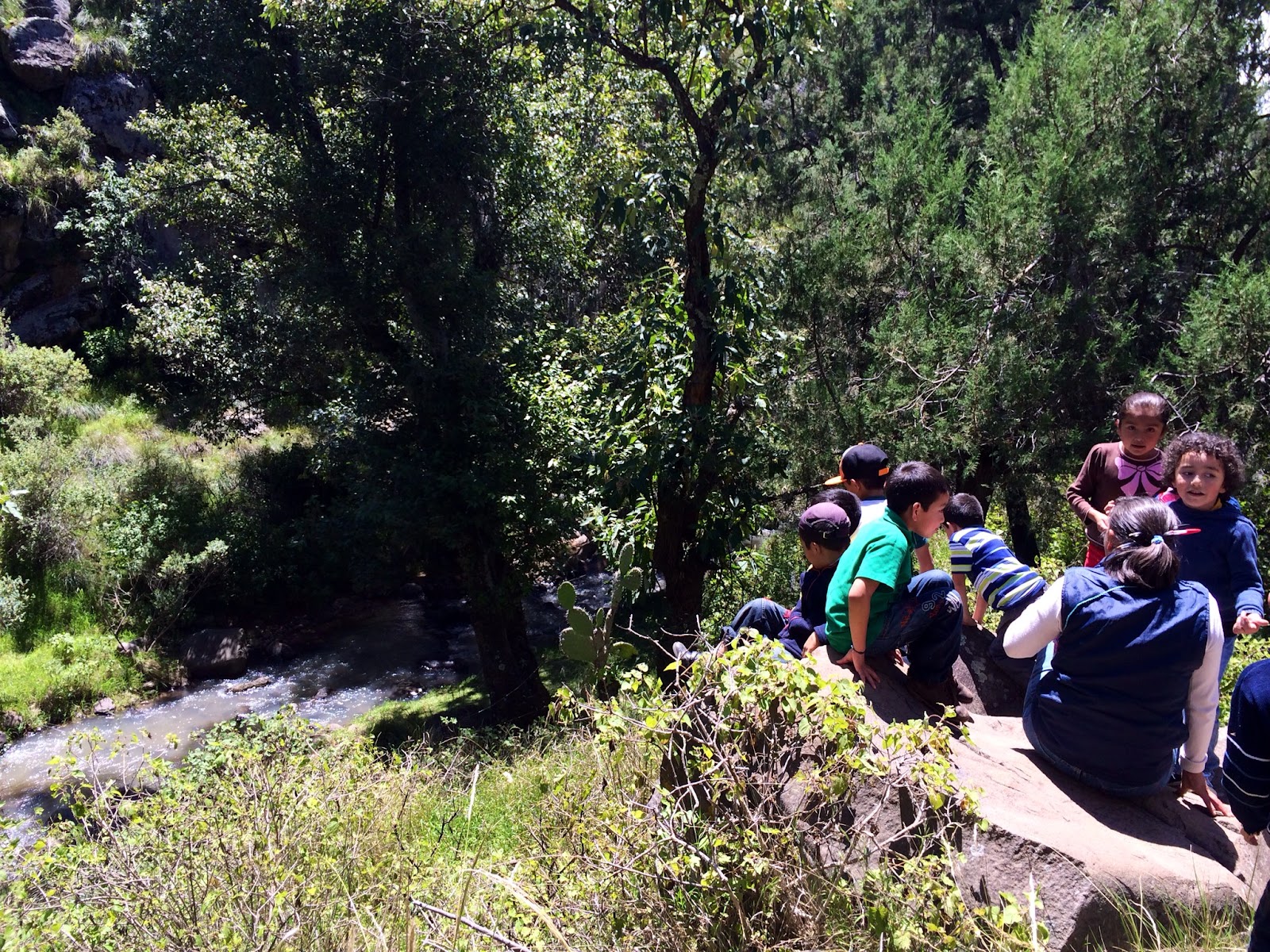
Every Tuesday this year at Instituto de Educación Integral de Magdalena Cervantes is outing day. Or día de las salidas al campo. Every grade experiences one class period out on the shores of the nearby river or in the fields and trails of the moutains beckoning just outside the school´s gate. I have the absolute honor of accompanying each of these groups. Tuesday is undoubtedly the best thing about being a YAGM at IEIMC. When it´s la hora de salir (time to leave) the children respond to the word "formense!" (line up!) with so much gusto their pens and notebooks are almost left spinning on their desks. After a mad dash to the school gate, the teacher performs one last head count (a very familiar move) and we´re off. As it is the tail end of the rainy season, we head to the river to take advantage of seeing its beauty before it dries up in dry winter season.


I´m pulled in a million directions as soon as we arrive the precious children are eager to show me their favorite spot to dip their feet in, the best rock for sitting and soaking up the sun , their favorite slope to roll down, the oldest and biggest cactus plant, and the best place to scamper up the rocks and admire the view. I watched classes of first and second graders sit in a circle and try to count the different types of trees around them. I saw the elation and surprise on their faces when they realized that there were too many to even count! I watched 3rd and 4th graders help each other to wade across the river so that all could be included in a game of tag on the opposite shore. I watched 5th and 6th graders get to just relax with their teacher, dip their toes in the water and talk about life.

The joys and benefits of outings are universal. By taking, even just an hour, to experience creation and the beauty of community without the bounds of our tiresome and meddlesome institutions we are treated to an incredible growth in relationship with one another and relationship with God. It´s no wonder that whenever Jesus meant serious business he went out-out to the mountain, out the dessert, out the sea, out the garden. Out into creation to experience it with His community. What a joy I have this year to get to go OUT and experience creation with mine.

 1st and 2nd graders pause and chat with their teacher about their experience